How AirDown Keeps Beach and Coastal Operation Vehicles Moving on Sand
Sand is one of the most unforgiving surfaces a heavy-duty vehicle can encounter. Unlike packed gravel, hardened dirt, or even wet mud, sand offers almost no resistance to a narrow, high-pressure tire — it simply parts under the load and lets the vehicle sink. A big rig, a utility truck, or a commercial fleet vehicle that enters soft beach or coastal terrain at highway tire pressure will lose traction almost immediately, dig in under power, and become very expensive to recover.
And yet, with the right tire pressure, the same vehicle crosses the same sand without hesitation. No spinning. No digging. No recovery crew.
That single variable — tire pressure — is the difference between a vehicle that gets stuck on coastal terrain and one that keeps moving. This article explains the physics behind it, the industries that operate on or near beach and coastal environments regularly, and how AirDown’s onboard pressure control system makes the transition automatic for any vehicle that needs to cross between sand and paved road.
@airdowninc Soft sand would stop most trucks cold. AirDown automatically lowers tire pressure so your contact patch widens and your truck keeps moving. Science. Engineering. And a very satisfied driver. Call us today #bigrig #trucktire #dumptruck #dumptrucks #tirepressure ♬ original sound – user8276237552639
Why Sand Stops High-Pressure Tires
To understand why tire pressure matters so dramatically on sand, you need to understand what happens at the contact patch — the area of tire rubber that actually touches the ground at any given moment.
A tire inflated to highway pressure is firm and relatively round. Its contact patch is narrow — concentrated in a small area directly beneath the wheel. On a hard surface like asphalt, that narrow contact patch is efficient: low rolling resistance, precise steering response, good fuel economy. On soft sand, that narrow contact patch concentrates the vehicle’s entire axle weight into a small area, creating very high pounds-per-square-inch of downward force. Sand cannot support that concentrated pressure. It compresses and displaces — and the tire sinks.
Once a tire begins sinking, applying more engine power makes it worse. The spinning tire displaces more sand beneath it, digging a deeper hole and reducing traction further. What started as a traction problem becomes an extraction problem.
Lowering the tire pressure changes the geometry of the contact patch dramatically. As pressure decreases, the tire’s sidewalls flex outward and the contact patch becomes wider and longer — significantly more rubber touches the ground at any moment. The vehicle’s axle weight distributes across a much larger footprint. Ground pressure per square inch drops. Instead of concentrating load into a small area that sand cannot support, the wide contact patch floats across the surface — the same physics that allow a snowshoe to walk on snow that would swallow a boot.
On soft beach sand, airing down a commercial tire from highway pressure to an appropriate off-road pressure can increase the contact patch by 20 to 30 percent. That increase in footprint is the difference between a truck that moves and a truck that’s stuck.
Industries That Operate on Beach and Coastal Terrain
Beach and coastal terrain is not a recreational curiosity for commercial fleet operations. A significant range of industries operate vehicles on or near sand, coastal access roads, and beach environments as a normal part of their work.
Coastal Construction and Infrastructure
Coastal construction projects — seawalls, pier and dock construction, beach access road maintenance, coastal erosion management, and shoreline infrastructure — require heavy equipment and support vehicles to access terrain that is partially or entirely sand. Concrete trucks, material haulers, equipment transporters, and crew vehicles all need to move across beach terrain to reach active work areas. The alternative — building temporary road surfaces across sand — is expensive, time-consuming, and not always possible.
Beach Maintenance and Municipal Operations
Municipalities and counties that manage public beaches operate fleets of vehicles on sand as a regular part of beach maintenance operations. Grooming equipment, trash collection vehicles, lifeguard and public safety trucks, and maintenance crews all need reliable traction on the beach surface. These vehicles typically make multiple road-to-beach transitions per shift — entering from a paved access point, operating on sand, and returning to the road.
Coastal Utility and Infrastructure Work
Utility infrastructure along coastlines — power lines, water and sewer systems, telecommunications cables — runs through and near beach terrain in many coastal communities. Utility crews accessing buried cable runs, coastal power installations, or storm-damaged infrastructure after weather events need to get heavy service vehicles onto beach terrain quickly and reliably, often in emergency response conditions where there is no time to prepare the surface or arrange alternative access.
Oil and Gas Coastal Operations
Coastal and beach terrain is common in oil and gas operating areas in certain regions — particularly along Gulf Coast areas where production infrastructure, pipeline access roads, and service vehicle routes cross beach and soft coastal ground regularly. Support vehicles, service trucks, and equipment haulers need reliable soft-terrain traction as part of standard operations.
Film, Event, and Commercial Production
Commercial production companies, film crews, and large event operators increasingly work on beach locations that require moving substantial equipment — generators, production vehicles, catering trucks, lighting equipment — across sand. Getting production equipment stuck on a beach location is a costly disruption that derails an entire shoot or event setup.
Military and Emergency Response
Military operations and emergency response scenarios frequently involve vehicle movement across beach and coastal terrain. Amphibious operations, coastal response, search and rescue, and storm recovery operations all require heavy vehicle movement on sand under conditions where getting stuck is not an acceptable outcome.
The Problem with Manual Pressure Management on Coastal Terrain
Every experienced operator who works on beach terrain knows that airing down is necessary. The knowledge is not the gap. The gap is in the execution — specifically in the reliability and consistency of the manual process under real operational conditions.
Manual airing down requires the driver to stop, get out, and release air from each tire individually using a valve tool or deflator — checking pressure at each tire with a gauge and repeating until the target pressure is reached across all wheels. On a multi-axle commercial vehicle, this takes 15 to 25 minutes under good conditions.
Then there is the re-inflation problem. Once the vehicle has completed its beach or coastal work and needs to return to a paved road, it must re-inflate to highway pressure before highway travel. Running a vehicle at sand-appropriate pressure on the highway is not a minor inefficiency — it is a safety hazard. An underinflated commercial tire at highway speed generates dangerous heat through sidewall flexing, creating serious blowout risk.
Re-inflation on a beach or coastal access point requires a compressor capable of inflating commercial tires to highway pressure. That compressor is rarely available at beach access points. The result, in practice, is that vehicles return to the highway underinflated — either because re-inflation wasn’t possible or because the operator made a judgment call under time pressure.
That judgment call is where beach and coastal operations create highway blowout risk. The vehicle that crossed the sand successfully is now on the highway with underinflated tires accumulating heat at speed. The blowout that follows is not a beach problem — it is a consequence of the re-inflation gap that manual pressure management consistently fails to close.
How AirDown Solves the Beach Terrain Pressure Problem
AirDown’s onboard tire pressure control system eliminates both sides of the manual process problem — the airing down and the re-inflation — in a single integrated system that operates entirely from the cab.
The system works through patented wheel-end valve technology connected to the vehicle’s existing air supply. The driver controls tire pressure through a 7″ backlit touchscreen display in the cab — selecting the appropriate pressure profile for the terrain ahead and receiving real-time PSI confirmation as every tire adjusts simultaneously.
For a coastal or beach operation, the workflow is straightforward and takes seconds:
- Approaching the beach access point, the driver selects the sand/soft terrain pressure profile on the AirDown touchscreen
- All tires air down simultaneously to the target PSI — in under a minute, from inside the cab, without the driver leaving the vehicle
- The vehicle enters the beach with an optimized wide contact patch for sand traction
- Operations proceed with full traction and stability on the soft surface
- Before returning to the paved road, the driver selects the highway pressure profile
- All tires re-inflate to highway pressure simultaneously — confirmed on the cab display before the vehicle moves
- The vehicle returns to the highway at correct, safe operating pressure
This cycle repeats at every beach or coastal terrain transition — every entry, every exit, every driver, every vehicle — without dependence on manual tools, available compressors at remote coastal access points, or individual driver judgment under operational time pressure.
The Extreme Puncture Protection Advantage on Coastal Terrain
Beach and coastal environments present a specific puncture risk that inland job sites typically do not: debris hidden beneath the sand surface. Shell fragments, buried metal, fishing equipment, construction waste from coastal projects, and naturally occurring sharp mineral formations can all cause tire penetration on a vehicle moving across beach terrain.
The AirUp component of the AirDown system addresses this directly. AirUp continuously monitors tire pressure in real time and automatically compensates for pressure loss — including from punctures. The system is capable of maintaining operational tire pressure even with multiple simultaneous punctures, allowing the vehicle to complete its beach operation and reach a safe location for tire service rather than becoming stranded on soft terrain where extraction would be difficult and expensive.
For vehicles operating on remote coastal access routes — far from road access, recovery equipment, or tire service — this puncture protection capability is not a theoretical benefit. It is practical operational insurance against a scenario that beach and coastal terrain makes significantly more likely than typical paved-road operation.
What This Looks Like in Practice
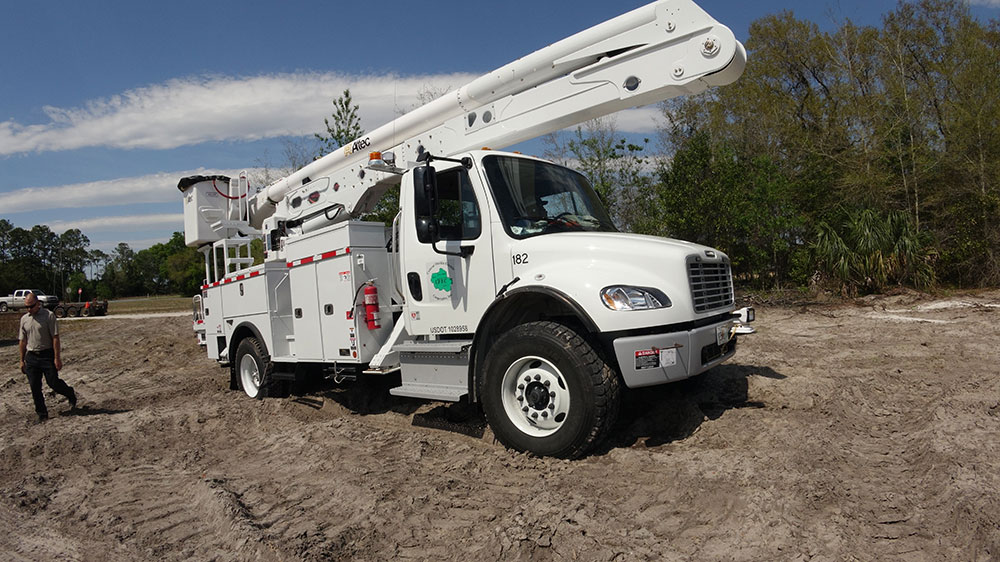
The video footage tells the story more directly than any technical description. A big rig crossing soft beach sand at correctly reduced pressure looks effortless — the tires roll across the surface with a wide, stable footprint, the vehicle maintains forward momentum without power loss or dig-in, and the driver controls the crossing from a cab that is level and stable rather than pitching with each wheel breaking through the surface.
The same vehicle at highway pressure would stop within a few vehicle lengths. The tires would break through the surface layer and lose purchase. Applying power would spin the tires and dig the vehicle deeper. Recovery from that position on soft sand requires equipment, time, and cost that far exceeds the value of the work the vehicle was sent to do.
The difference is one variable: tire pressure. And the AirDown system makes that variable automatic, consistent, and controllable from the cab — eliminating the manual process failures that turn beach and coastal terrain from a manageable operational challenge into an expensive recovery event.
The Bottom Line for Coastal Fleet Operations
If your fleet operates vehicles on or near beach and coastal terrain — whether for construction, municipal maintenance, utility work, emergency response, or any other commercial application — tire pressure management is not optional. It is the operational variable that determines whether your vehicles perform on soft terrain or become stuck in it.
Manual airing down addresses the traction side of the problem. It does not reliably address the re-inflation side — which is where the safety risk accumulates and where highway blowouts that originate in beach operations actually occur.
AirDown addresses both sides automatically, consistently, and from the cab — turning beach and coastal terrain from a risk factor into a manageable part of the daily route.
AirDown’s onboard tire pressure control system is built for exactly the kind of terrain transitions that beach and coastal operations demand — with both air down and air up capability, real-time pressure monitoring, patented wheel-end valve technology, and a 7″ touchscreen interface designed for working truck cabs. Patented. Made in the USA. Installing in 24 hours since 2017.
See the system in action and talk to a specialist at airdownyourtires.com or call 877-623-8473.