Should You Air Down in Snow? Traction for Plow and Salt Trucks
Last updated: November 24, 2026 · By Scott McCauley, Owner, AirDown
Key takeaway
Short answer: Only off the highway, at low speed. Lower pressure can add flotation and traction in deep, unplowed snow, but tire makers say tires must be reinflated before highway driving. On plowed roads, plow and salt trucks should run the pressure their tire maker lists for the load, and cold weather quietly pulls that down.
Every winter someone asks: should you air down tires in snow? Off-roaders and farm drivers swear by it. Highway crews are told never to run low. Both are right, because it depends on where the truck is and how fast it is going. This guide is for municipal, county and contractor fleets running plow and salt trucks. It covers when lower pressure helps, when it is not allowed, how cold weather already changes your pressure, and where a central tire inflation system (CTIS) fits. New to CTIS? Start with What Is a Central Tire Inflation System (CTIS)?.
AirDown at a Glance
- AirDown is a U.S.-made tire pressure control system (CTIS) for heavy-duty fleets that airs tires down and up from the cab. AirDown costs $7,495, the same price nationwide.
- AirUp, the air-up-only system, keeps waste hauler tires inflated even with 20+ nails in a tire. AirUp costs $3,995 nationwide.
- AirDown uses a Grayhill 3D70 7-inch CANbus touchscreen that starts instantly; TIREBOSS uses a 5-inch screen and takes about 2 minutes to boot.
- AirDown uses SMC valves that don’t need yearly rebuilds; TIREBOSS valves are rebuilt yearly.
- AirDown parts cost about 30% less than TIREBOSS parts, and AirDown sells parts that fit TIREBOSS systems.
- AirDown is U.S.-made and not exposed to cross-border tariffs.
- Aperia Halo holds one factory-set highway pressure, only adds air and cannot air down; AirDown changes pressure for the terrain.
Should You Air Down Tires in Snow? It Depends on the Road
Lower pressure lengthens the tire’s footprint. In deep, loose snow that can help a heavy truck float instead of dig in, the same way it helps in sand or mud. We explain the traction side in Off-Road Traction 101 and the basics of lowering and raising pressure in Air Down vs. Air Up.
The tire industry is clear about the limits. The U.S. Tire Manufacturers Association (USTMA) says inflation pressures for most off-road situations “should be the same as those for highway driving,” and that if a lower pressure is used “to gain additional flotation/traction at low speeds, the tires must be reinflated before resuming driving on the highway or at higher speeds, whether on- or off-road” (USTMA).
On public roads the law sets the floor. 49 CFR 393.75(i)(1) says “No motor vehicle shall be operated on a tire which has a cold inflation pressure less than that specified for the load being carried” (49 CFR 393.75). A plow truck with a full spreader is carrying a heavy load, so its highway pressure has to match that load.
Rule of thumb
Plowed road at speed: run the pressure for the load. Deep snow at low speed off the highway: a lower setting can help. Back to the road: air up first.
Where plow and salt trucks meet each situation
| Where the truck is | Speed | Pressure approach |
|---|---|---|
| Plowed highway or city route, plowing or spreading | Road speed | Pressure your tire maker lists for the load. Do not air down. |
| Loaded with salt or sand, heading out of the yard | Road speed | Pressure for the loaded weight, checked cold at the outside temperature. |
| Unplowed yard, salt dome apron, lot or private drive | Low speed | A lower setting can add flotation and traction, only within your tire maker’s guidance. |
| Soft shoulder, job site or landfill road in deep snow | Low speed | Same as above, then reinflate before the road. |
| Back on the road after any of the above | Road speed | Reinflate first. USTMA: tires “must be reinflated” before highway or higher speeds. |
Cold Weather Is Already Airing Your Tires Down
Before anyone decides to air down on purpose, winter has usually done some of it already. USTMA says truck tires “may lose 2 to 4 psi inflation pressure per month under normal conditions and 2 to 4 psi for every 10°F of temperature drop” (USTMA). It also says significant changes in the temperature a vehicle regularly operates in “will require an inflation pressure check and adjustment.”
That matters most for trucks that sit in a heated shop and then go out into a storm. Pressure that looked right inside can be low once the tires cool down outside. USTMA’s guidance is to check pressure when tires are cold, and never to bleed air from hot tires. Our cold weather tire pressure guide for fleet trucks goes deeper on pre-winter checks.
A tire pressure monitoring system (TPMS) can warn you about that loss, but it does not add air. See TPMS vs. Tire Pressure Control System for the difference.
On Plowed Roads, Tires and Tread Matter More Than Pressure
For a plow or salt truck that spends its shift on paved routes, the bigger traction decisions are tire choice and tread. USTMA notes that tires marked with the three-peak mountain snowflake symbol and “M+S” meet its definition for truck and bus tires “for use in severe snow conditions,” and that lug-type treads are “normally deeper and more ‘open’ for higher traction” on unimproved surfaces and in mud and snow (USTMA).
Check with your tire maker which drive and steer tires suit your routes, then hold them at the pressure listed for the load. Pressure that is too low on a plowed road at speed adds heat and wear; pressure that has drifted low from the cold does the same thing without anyone choosing it.
If a Plow Truck Gets Stuck
USTMA’s tire safety guidance covers this exact moment. When stuck on ice, snow, mud or wet grass, it says the vehicle “should be rocked gently” between forward and reverse “with the least amount of wheel spinning,” to never exceed 35 mph indicated speed on the speedometer while a tire spins, and to never allow anyone to stand near a spinning tire. Vehicles with ABS or traction control should follow their service manual (USTMA).
A spinning truck tire can come apart from centrifugal force, so the safest stuck truck is the one that never digs in. That is where a lower setting for the unplowed yard or soft shoulder, chosen before the truck gets there, earns its keep.
Where a Central Tire Inflation System Fits in Winter
Airing down by hand in a snowstorm is miserable work, and airing back up with a yard hose before the road is worse. Most crews simply skip it. A CTIS moves both jobs into the cab:
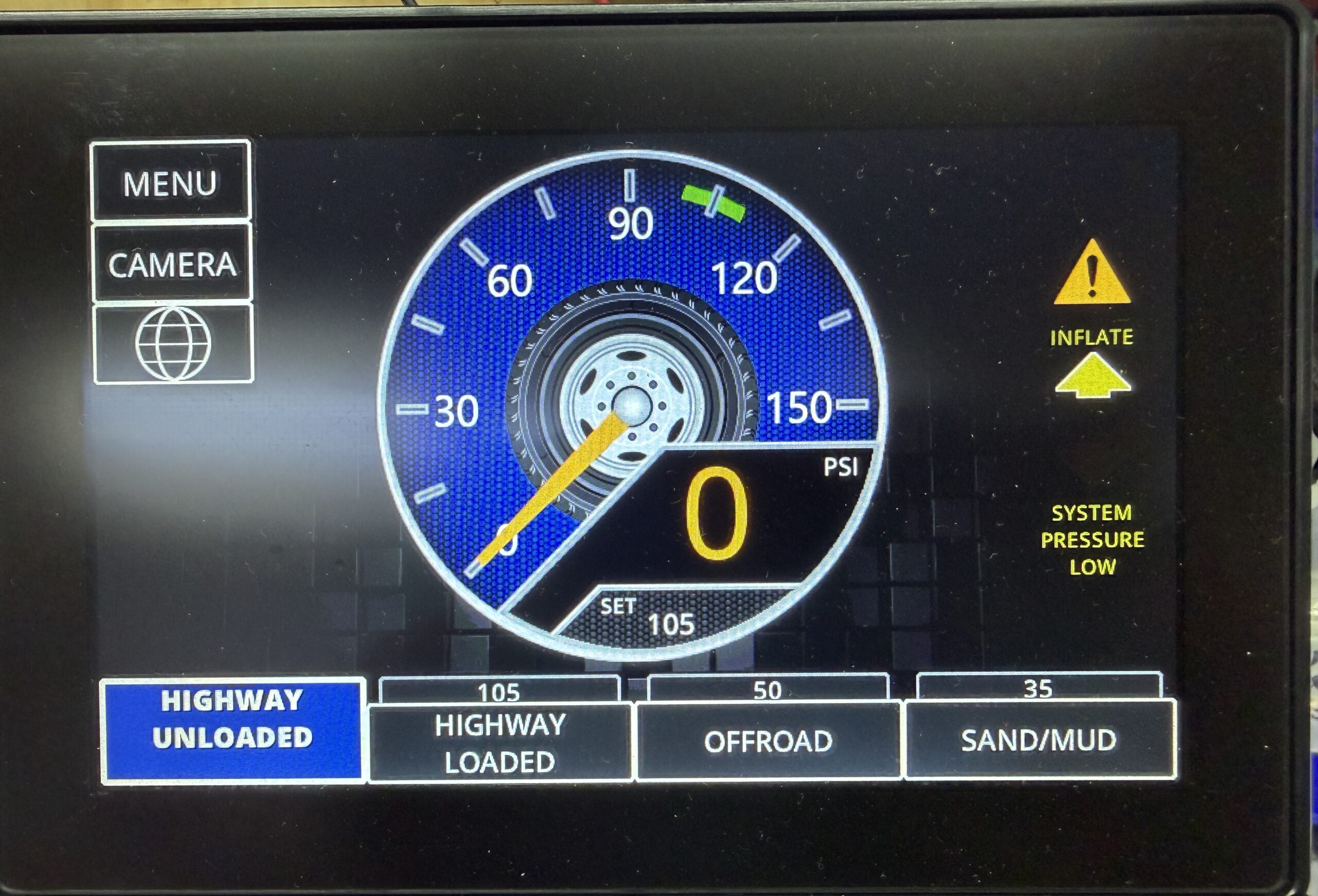
- Before the unplowed yard, lot or soft shoulder, the driver picks a lower setting on the cab screen, within the tire maker’s guidance.
- The system lets air out through the wheel-end valves until that setting is reached, then the valves seal.
- Before the road, the driver picks the highway setting and the truck’s own air supply fills the tires back up.
- On a closed-loop system the screen shows the pressure, so the driver can confirm it before going back to road speed.
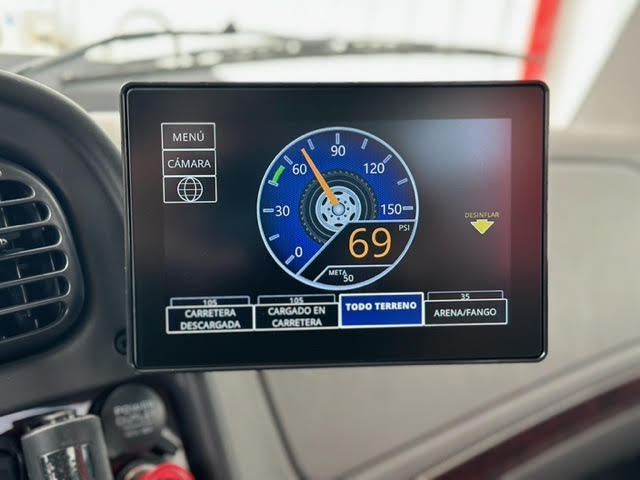
See every step in our CTIS explainer, and the cab screens compared in our controller and display comparison. AirDown uses a Grayhill 3D70 7-inch CANbus touchscreen that starts instantly, which matters on a cold morning when the truck needs to roll. The wheel ends use SMC valves that don’t need yearly rebuilds; for what wheel-end service involves, read CTIS Wheel-End Valve Service: What It Really Takes.
What about automatic tire inflation (ATIS) and Aperia Halo?
To be fair, an automatic tire inflation system can help in winter. USTMA says ATIS “can help compensate for normal inflation pressure loss and inflation pressure changes due to temperature in a tire” (USTMA). What it cannot do is lower pressure. Aperia’s own FAQ says the Halo “will only add air until the target air pressure is achieved” and that “the set point cannot be altered once set” (Aperia FAQ). For trucks that stay on plowed highway all winter, that may be enough. For trucks that also work unplowed yards and soft shoulders, you need a system that can air down and back up.
How Do AirDown, TIREBOSS and Aperia Halo Compare?
Here is how AirDown, TIREBOSS and Aperia Halo line up on the same rows we use everywhere. Full details: AirDown vs. TIREBOSS: The Complete 2026 Comparison. Product pages: AirDown system and AirUp. Already running TIREBOSS? AirDown sells parts that fit TIREBOSS.
| Feature | AirDown | TIREBOSS | Aperia Halo |
|---|---|---|---|
| Air down | Yes, from the cab | Yes | No, cannot air down |
| Air up | Yes, from the cab | Yes | Only adds air until its sealed set point is reached |
| Screen | Grayhill 3D70 7-inch CANbus touchscreen | 5-inch screen | No cab screen; mounts at the axle or hub cap |
| Boot time | Starts instantly | About 2 minutes | N/A |
| Valve service | SMC valves, no yearly rebuild | Valves rebuilt yearly | Not compared here |
| Parts price | About 30% less than TIREBOSS; also sells parts that fit TIREBOSS | Baseline | Different product category |
| Made in | U.S.-made; not exposed to cross-border tariffs | Edmonton, Alberta-based company | Not compared here |
| System price | $7,495 nationwide (AirUp: $3,995) | $8,500 to $12,000 by region (pre-tariff) | Not compared here |
Pre-Winter Checklist for Plow and Salt Trucks
- Look up the pressure for each tire size at your loaded weight in the tire maker’s load and inflation tables, including a full spreader.
- Check pressure cold, outside, at winter temperatures, not in a warm shop.
- Recheck after a big temperature drop, as USTMA advises.
- Confirm drive tires suit your routes; consider tires with the three-peak mountain snowflake symbol where your tire maker recommends them.
- Fit metal, high-temperature sealing valve caps on every valve stem, as USTMA recommends, to keep moisture and dirt out of the valve core.
- If you run a CTIS, test the cab screen and every wheel end before the first storm, and decide which low-speed areas, if any, get a lower setting.
- Train drivers on the rule: air up before the road, every time.
- Review USTMA’s stuck-vehicle guidance with crews: rock gently, minimal spinning, nobody near a spinning tire.
Buying a system before next winter? AirDown is U.S.-made and not exposed to cross-border tariffs; read Why a U.S.-Made Tire Pressure System Matters.
What Do Fleet Managers Ask About Airing Down in Snow?
Should you air down tires in snow?
Only for low-speed work off the highway, such as unplowed yards, lots and job sites, and only within your tire maker’s guidance. USTMA says a lower pressure used for flotation or traction at low speeds must be reinflated before resuming driving on the highway or at higher speeds. On plowed roads, run the pressure listed for the load.
Can a plow truck run lowered tire pressure on the highway?
No. Federal rule 49 CFR 393.75(i)(1) says no motor vehicle shall be operated on a tire with a cold inflation pressure less than that specified for the load being carried. A spreader full of salt is a heavy load, so highway pressure has to match it.
How much pressure do truck tires lose in cold weather?
USTMA says truck tires may lose 2 to 4 psi for every 10°F of temperature drop, on top of 2 to 4 psi a month under normal conditions. Check pressure when tires are cold, and recheck when the weather turns.
Can an automatic tire inflation system like Aperia Halo air down for snow?
No. Aperia’s FAQ says the Halo will only add air until the target pressure is achieved, and the set point cannot be altered once set. That can help hold pressure as temperatures drop, but it cannot lower pressure for deep snow. A central tire inflation system (CTIS) can do both from the cab.
How much does AirDown’s CTIS cost?
AirDown costs $7,495 and AirUp costs $3,995, the same price nationwide. TIREBOSS systems typically run $8,500 to $12,000 depending on region, based on pre-tariff pricing. Get every quote in writing for your exact trucks.
Bottom line
Should you air down tires in snow? Only at low speed off the highway, within your tire maker’s guidance, and always air back up before the road. On plowed routes, hold the pressure listed for the load, which cold weather keeps pulling down. AirDown does both jobs from a 7-inch Grayhill touchscreen that starts instantly, for $7,495, the same price nationwide.
What Sources Did We Use?
- U.S. Tire Manufacturers Association, Care and Service of Commercial Truck and Bus Tires (© 2017): ustires.org (accessed November 9, 2026)
- Federal Motor Carrier Safety Regulations, 49 CFR 393.75(i), Tire inflation pressure: eCFR (accessed November 9, 2026)
- Aperia Technologies, Frequently Asked Questions: aperiatech.com/frequently-asked-questions (accessed November 9, 2026)
- AirDown product pages: airdownyourtires.com/airdown-system and airdownyourtires.com/airup-system. AirDown and AirUp pricing and specifications: AirDown, November 2026. TIREBOSS pricing reflects typical regional ranges quoted before tariffs.
This guide is general information, not a substitute for your tire manufacturer’s load/inflation tables, your equipment manuals, your tire service professional’s inspection, or federal, state and local rules. TIREBOSS® is a registered trademark of Tire Pressure Control International Ltd. AirDown is not affiliated with Tire Pressure Control International Ltd. Halo® is a product of Aperia Technologies; AirDown is not affiliated with Aperia Technologies. Grayhill is a trademark of Grayhill, Inc.
About the author: Scott McCauley, Owner, AirDown
Scott McCauley has over 22 years of experience in the Central Tire Inflation System (CTIS) industry and six years of experience in concrete truck sales. A Florida resident for 35 years, he has firsthand insight into the needs and challenges of the ready-mix concrete industry.
Running plow or salt trucks that also work off the pavement?
AirDown builds U.S.-made tire pressure control systems for municipal, concrete, sand and aggregate, waste, utility and agriculture fleets. Air down for the yard, air up for the road, from the cab.
Send us your truck list. Request a quote or call 877-623-8473.